Beyond the Cyst: Understanding PMOS, the New Name for PCOS, and Why This Medical Shift Empowers Indian Women
For decades, a significant portion of the Indian female population has struggled with a diagnosis that never quite felt accurate: Polycystic Ovary Syndrome (PCOS) . If you are one of the millions of women in India dealing with irregular periods, stubborn weight gain, adult acne, or difficulty conceiving, you might have been told you have “cysts” on your ovaries. This description often led to confusion, fear, and a narrow focus on fertility alone.
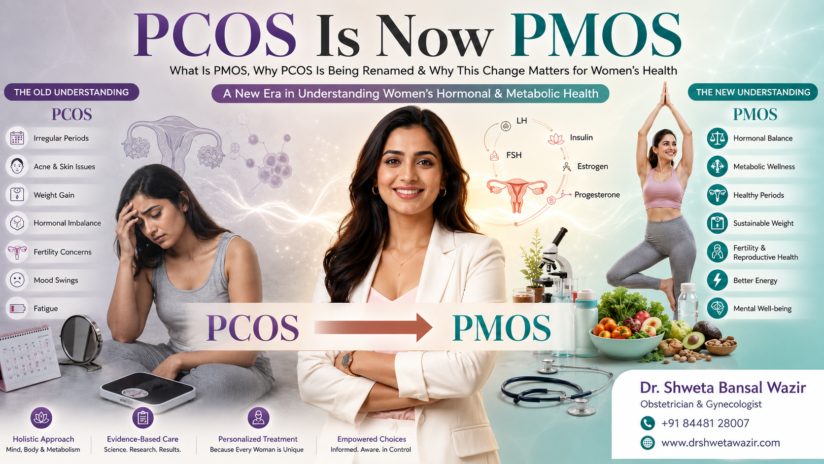
However, in a landmark shift published in The Lancet in May 2026, a global consensus of 56 leading medical organizations has officially renamed the condition. What you knew as PCOS is now Polyendocrine Metabolic Ovarian Syndrome (PMOS) .
At Silvernest Clinic, led by renowned gynecologist Dr. Shweta Bansal Wazir (MBBS, DGO, MD), we believe this is more than just a terminology change. It is a revolution in how we understand women’s health in India. This article explains what PMOS means, why your old diagnosis is still valid, and how this change can finally lead to the holistic healing you deserve. *(For expert guidance, you can consult Dr. Shweta Wazir at Silvernest Clinic, Gurgaon, or call +91 84481 28007)*.
What Is PMOS? A New Era for an Old Syndrome
Under the new nomenclature, PMOS stands for Polyendocrine Metabolic Ovarian Syndrome. Let us break that down to understand why this matters specifically for the Indian female body:
- Polyendocrine: This acknowledges that the issue involves multiple hormones. It’s not just about the ovaries; it involves the brain (hypothalamus), the adrenal glands, and the pancreas (insulin).
- Metabolic: This places Insulin Resistance at the center of the diagnosis. For Indian women, who have a genetic predisposition to metabolic syndrome, this is the most critical part of the new name .
- Ovarian: While the name moves away from “cysts,” it retains that the ovaries are affected (leading to irregular ovulation or egg quality issues).
The “Cyst” Myth: Why the Change Was Necessary
The primary driver for the change from PCOS to PMOS was scientific inaccuracy. The previous name implied the presence of pathological “cysts” (fluid-filled sacs). In reality, the “polycystic” appearance seen on an ultrasound is actually a buildup of arrested follicles, eggs that tried to grow but got stuck due to hormonal imbalance .
Did you know? Up to 70% of women with PMOS remain undiagnosed globally . In India, the prevalence is alarmingly high, affecting between 16% to 18% of women, far exceeding global averages . The old name, focused solely on the ovaries, delayed diagnosis because many women without “cysts” on scans were told they were fine, even while suffering from severe metabolic symptoms.
The Metabolic Reality: Why Insulin Resistance Is the Real Culprit
For the Indian woman, the shift from PCOS to PMOS is a wake-up call regarding metabolic health. Research indicates that the South Asian phenotype is unique; we store more visceral fat (the dangerous fat around our organs) at a lower Body Mass Index (BMI) compared to Western populations .
The Vicious Cycle of PMOS
- High Insulin: Due to genetics or lifestyle (high refined carb intake, stress), your body stops responding to insulin. The pancreas pumps out more insulin to compensate.
- High Androgens: This excess insulin travels to the ovary and triggers the production of male hormones (Androgens) .
- Symptoms: High Androgens cause acne, hair loss (androgenetic alopecia), and facial hair (hirsutism). High insulin tells your body to store belly fat and makes weight loss incredibly difficult .
This understanding is liberating. It means PMOS is not a lifestyle “judgment” but a metabolic condition that can be managed.
PMOS in the Indian Context: Why It Hits Us Harder
In India, PMOS is often viewed purely as a “gynecological” problem or a fertility blocker. Consequently, young women are frequently prescribed birth control pills to “regulate” periods without addressing the underlying insulin resistance.
The Cultural and Dietary Gap
The typical Indian diet, often rich in rice, parathas, sweets, and hidden sugars in chai—can spike blood glucose levels. When coupled with a sedentary urban lifestyle, this creates the perfect storm for PMOS. Women with “Lean PCOS” (normal weight but high visceral fat) are often overlooked because doctors do not suspect metabolic issues .
Why Holistic Care is Non-Negotiable
As Dr. Shweta Wazir advocates in her practice at Silvernest Clinic, PMOS cannot be treated with medication alone. It requires a multidisciplinary approach involving gynecology, endocrinology, nutrition, and fitness. The name change validates what holistic doctors have said for years: You cannot “pill” your way out of a metabolic disorder.
How Is PMOS Diagnosed? (The New Criteria)
Don’t worry, if you were previously diagnosed with PCOS, you do not need to be “re-diagnosed.” However, the new name encourages doctors to look deeper.
According to the latest guidelines, a diagnosis of PMOS requires at least two of the following three criteria, after ruling out other thyroid or hormonal disorders :
- Irregular Ovulation: Menstrual cycles longer than 35 days or fewer than 8 cycles a year.
- Hyperandrogenism: Clinical signs (acne, hair growth, hair thinning) or blood tests showing high male hormones.
- Polycystic Ovarian Morphology: Ultrasound showing 12 or more follicles (small eggs) on an ovary (this is the “old” cyst criteria).
Important Addition: The new guidelines push for metabolic screening (HOMA-IR, HbA1c, and lipid profiles) as a standard part of the workup .
The Solution: A Patient-Friendly Guide to Reversing PMOS
The renaming to PMOS offers a clear blueprint for healing. Here is how Indian women can take charge of their health, moving from fear to empowerment.
1. Shift the Focus from “Fertility” to “Metabolism”
Stop worrying only about getting your period. Focus on lowering your fasting insulin. When your insulin normalizes, your periods often follow naturally.
2. The Power of Protein and Fiber
You don’t need to starve; you need to eat smarter. To manage PMOS:
- Reduce: White rice, maida, sugary chai, packaged juices, and biscuits.
- Increase: Protein (paneer, eggs, chicken, dal, legumes). Aim for 1.4–1.6 grams of protein per kg of body weight .
- Sequence: Eat your veggies and protein before your carbs to blunt the glucose spike.
3. Resistance Training Over Cardio
While walking is great, women with PMOS need muscle. Muscle is your body’s best sink for absorbing glucose. Lifting weights or doing yoga (like Surya Namaskar) just 3 times a week can significantly improve insulin sensitivity .
4. Don’t Ignore the Mental Health Link
The hormonal chaos of PMOS leads to high rates of anxiety and depression in Indian women . The social stigma of facial hair or weight gain adds to this burden. The new name, removing the scary “cyst” label, helps destigmatize the condition, making it easier to discuss openly with family and doctors.
Conclusion: A Call for Change in Women’s Healthcare
The transition from PCOS to PMOS is not just an academic exercise; it is a lifeline for the 170 million women affected worldwide . For India, it is an opportunity to stop ignoring the root causes of hormonal chaos.
If you are suffering from irregular cycles, weight loss resistance, or infertility, look for a doctor who treats you, not just your ultrasound report.
Take the Next Step with an Expert
Navigating PMOS requires a trusted partner. Dr. Shweta Bansal Wazir at Silvernest Clinic (located in Gurgaon) is a highly respected Obstetrician & Gynecologist with over 20 years of experience. Trained in India and the UK (Queen Elizabeth Hospital, Newcastle), Dr. Shweta specializes in high-risk pregnancy, infertility, and metabolic management of gynecological disorders.
Don’t let a name define your fear. Let the understanding of PMOS define your path to recovery.
📍 Visit: 198 First Floor, Eros City Square Mall, Rosewood City Rd, Sector 49, Gurugram, Haryana 122018.
📞 Contact: +91 84481 28007


Leave A Comment