For a young woman who trains several hours every week, a missed period may initially seem like a small issue. An athlete may think, “My training is intense, so this must be normal.” A coach may assume it is simply part of competitive sport. A parent may wait for the menstrual cycle to return on its own.
But periods are more than a monthly inconvenience. They can provide important information about a woman’s reproductive and overall health.
This is where Sports Gynecology becomes important.
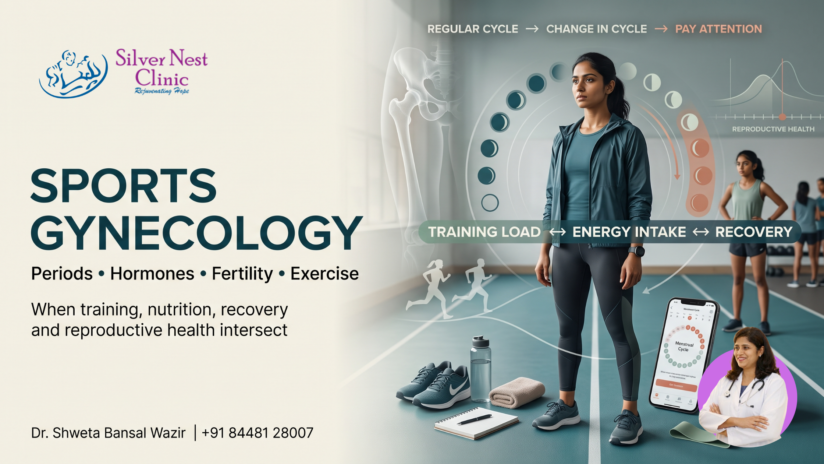
Sports gynecology focuses on women’s reproductive and hormonal health in relation to exercise, training, nutrition and athletic performance. It can help girls and women understand changes in their menstrual cycles, investigate hormonal problems, protect bone health and address questions about contraception, fertility and pregnancy while remaining physically active.
What Is Sports Gynecology?
Sports Gynecology is an area of women’s healthcare that considers how exercise, training, nutrition, menstrual health and reproductive health interact.
An athlete’s body has to balance the energy required for training with the energy needed for normal physiological functions. When energy intake is not sufficient for the body’s needs, menstrual function and other systems can be affected.
The IOC describes Relative Energy Deficiency in Sport (RED-S) as a condition associated with problematic low energy availability that can affect reproductive function, bone and musculoskeletal health, immunity, cardiovascular and metabolic health, and athletic performance.
This means that an irregular period should not automatically be dismissed as “part of being an athlete.”
Periods and Athletes: Is an Irregular Menstrual Cycle Normal?
Menstrual cycles naturally vary, particularly during adolescence when periods may still be becoming established. However, persistent or significant changes deserve attention.
An athlete may notice:
- Periods becoming less frequent
- Longer gaps between periods
- Very light menstrual bleeding
- Repeatedly missed periods
- Periods stopping completely
- Changes in menstrual symptoms
- A previously regular cycle becoming unpredictable
The important question is not simply, “Do you get your period?” It is also whether your menstrual pattern has changed from what is normal for you.
The established Female Athlete Triad framework recognises the relationship between low energy availability, menstrual dysfunction and reduced bone health. Early recognition is important because menstrual disturbances can occur alongside other health consequences.
Why Can Intense Exercise Affect Periods?
Exercise itself is not harmful to menstrual health. In fact, regular physical activity has many health benefits.
The concern arises when training demands become greater than the body’s available energy and recovery resources.
Imagine a young athlete increasing her training from four days a week to six or seven days. At the same time, she begins restricting carbohydrates or skipping meals because she wants to maintain a particular body weight. Her training continues, but her nutritional intake does not adequately support her increased energy requirements.
Over time, the body may reduce functions that are not immediately essential for survival, including normal reproductive hormone signalling.
This can contribute to menstrual disturbances associated with low energy availability.
Therefore, a missed period is not necessarily a sign that an athlete is “training well.” Sometimes, it is a sign that the body needs more energy, recovery or medical evaluation.
Hormonal Changes in Female Athletes
The menstrual cycle is controlled by a complex interaction between the brain, pituitary gland and ovaries.
When energy availability becomes too low, the hormonal signals responsible for normal reproductive function can be disrupted. This may affect ovulation and menstrual cycles.
This is particularly relevant for athletes involved in sports where body weight, endurance, appearance or a particular physique is emphasised.
However, irregular periods do not always result from exercise or low energy availability.
Other causes can include:
- Polycystic ovary syndrome (PCOS)
- Thyroid disorders
- High prolactin levels
- Pregnancy
- Certain medications
- Primary ovarian insufficiency
- Significant weight changes
- Other hormonal or medical conditions
That is why simply telling an athlete to “eat more” or “train less” without understanding the underlying cause may not be appropriate.
Missed Periods in Athletes: When Should You See a Gynecologist?
A missed period should not be ignored simply because you exercise regularly.
A gynecological evaluation becomes particularly important when periods repeatedly disappear, become significantly irregular, or were previously regular and then change.
It is also important to seek medical advice if menstrual changes occur together with:
- Significant weight loss
- Persistent fatigue
- Recurrent injuries
- Stress fractures
- Reduced athletic performance
- Restrictive eating
- Anxiety around food or body weight
- Excessive training without adequate recovery
The Female Athlete Triad consensus recommends careful assessment of menstrual history, nutrition, weight-related concerns and previous bone stress injuries when athletes are at risk.
For adolescent girls, menstrual health is particularly important because the teenage years are an important period for building bone mass.
Sports, Bone Health and Stress Fractures
One of the reasons menstrual health matters to athletes is bone health.
When low energy availability is accompanied by hormonal suppression, bone health can be affected. Female athletes with menstrual irregularities may have an increased risk of bone stress injuries and stress fractures, particularly when other risk factors are present.
A sportswoman who repeatedly develops stress injuries should therefore not only receive treatment for the injury itself. Her menstrual pattern, nutrition, training load and overall health may also need assessment.
The aim is to understand why the injury is occurring rather than repeatedly treating the same problem without addressing possible contributing factors.
Exercise and Fertility: Can Sports Affect the Ability to Get Pregnant?
This is an important concern for women who want to remain active while planning their future families.
Regular exercise does not mean that a woman will become infertile. However, persistent low energy availability and associated menstrual dysfunction can interfere with normal reproductive function and ovulation.
If periods have stopped because of functional hypothalamic suppression related to inadequate energy availability, ovulation may also be affected.
This does not mean that fertility is permanently lost.
The appropriate approach is to identify the underlying cause, improve energy availability and nutrition where necessary, review training and recovery, and assess other possible medical causes of menstrual dysfunction.
Women planning pregnancy should discuss their menstrual history and training routine with their gynecologist rather than assuming that irregular periods are simply a consequence of sport.
Nutrition and Recovery Are Part of Sports Gynecology
Training is only one part of athletic health.
An athlete needs sufficient energy not only to complete a workout but also to support the heart, brain, reproductive system, bones, immune system and other normal body functions.
A sportswoman with irregular periods may need an assessment of her overall dietary intake, training schedule and recovery.
Depending on the individual situation, care may involve a gynecologist, sports physician, dietitian, physiotherapist or other healthcare professionals.
The goal is not necessarily to stop sport. It is to find a healthier balance between training, nutrition, recovery and reproductive health.
Sports Gynecology for Teen Girls: Why Early Attention Matters
Young athletes may be particularly vulnerable to overlooking menstrual problems.
A teenager may be uncomfortable discussing her periods with a coach or doctor. She may also believe that missing periods is simply evidence of intense training.
Parents and coaches can help by treating menstrual health as a normal part of health discussions.
Questions such as “When was your last period?” and “Have your cycles changed?” can sometimes identify a problem much earlier.
The Female Athlete Triad consensus specifically recommends screening younger athletes and emphasises early recognition of menstrual dysfunction and other risk factors.
A period should not be treated as an inconvenience that an athlete is expected to sacrifice for performance.
What Happens During a Sports Gynecology Consultation?
A consultation is not simply about performing a pelvic examination.
Your gynecologist may first ask about:
- Age at first period
- Usual menstrual cycle
- Recent changes in periods
- Training frequency and intensity
- Nutrition and dietary restrictions
- Recent weight changes
- Sleep and recovery
- Previous injuries or stress fractures
- Medications and supplements
- Pregnancy possibility
- Fertility plans
- Symptoms suggesting PCOS, thyroid disease or another hormonal condition
Depending on the history, the doctor may recommend pregnancy testing, blood investigations, hormonal evaluation, nutritional assessment or imaging.
The investigations should be selected according to the individual woman’s symptoms and clinical history rather than assuming that every athlete needs the same set of tests.
When Should a Sportswoman See a Gynecologist?
You do not need to wait until a problem becomes severe.
Consider a gynecological consultation if you notice repeated missed periods, significant cycle changes, persistent pelvic symptoms, unusual bleeding, recurrent stress injuries, concerns about fertility, symptoms of hormonal imbalance or difficulty balancing training with your menstrual and general health.
Athletes who are increasing their training significantly, especially adolescents and women participating in high-volume endurance or weight-sensitive sports, may also benefit from proactive health guidance.
Sports Gynecology Is About Health as Well as Performance
Being a strong athlete and having good reproductive health should not be treated as competing goals.
A healthy menstrual cycle can provide useful information about how the body is responding to training, nutrition and recovery. When periods become irregular or disappear, the change deserves attention rather than being automatically accepted as part of sport.
Sports Gynecology gives girls and women a place to discuss these concerns openly from periods and hormonal changes to bone health, fertility and pregnancy planning.
The objective is not to make women choose between their sport and their health. It is to understand what the body needs so that training and reproductive health can be managed together with appropriate medical guidance.
About Dr. Shweta Bansal Wazir
Dr. Shweta Bansal Wazir, MBBS, DGO, MD (Obs & Gyn), MRCOG (UK), is an Obstetrician and Gynecologist providing evidence-based women’s healthcare, including reproductive and hormonal health. Her approach focuses on understanding each woman’s individual symptoms, lifestyle and reproductive goals and providing personalised guidance for menstrual health, fertility, pregnancy planning and gynecological concerns.
For personalised consultation regarding menstrual irregularities, exercise-related reproductive concerns or fertility planning, contact Dr. Shweta Bansal Wazir at +91 84481 28007.



Leave A Comment