
Best Gynecologist Clinic in Gurgaon


September 21, 2026
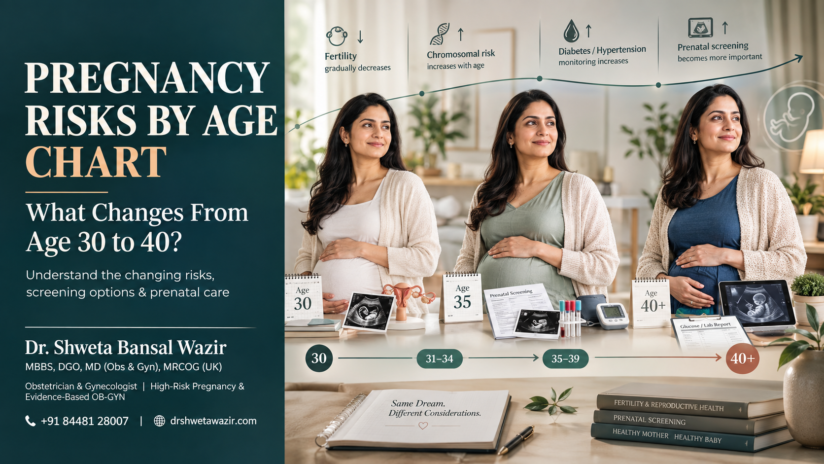
A woman may feel physically ready for pregnancy at 30, 34, 37 or 41, but pregnancy does not remain biologically identical throughout these years. Fertility gradually changes with age, and some pregnancy-related risks become more common as women move through their 30s and into their 40s.
This does not mean that pregnancy after 35 or 40 will necessarily be difficult. Many Indian women have healthy pregnancies and healthy babies in their late 30s and 40s. Age is one factor among many, and overall health, previous pregnancy history, weight, blood pressure, blood sugar, lifestyle and access to appropriate antenatal care also influence outcomes.
The following pregnancy risks by age chart provides a simple way to understand what generally changes from age 30 to 40 and why prenatal care may become more individualized with increasing age.
Pregnancy Risks by Age Chart: 30, 31–34, 35–39 and 40+
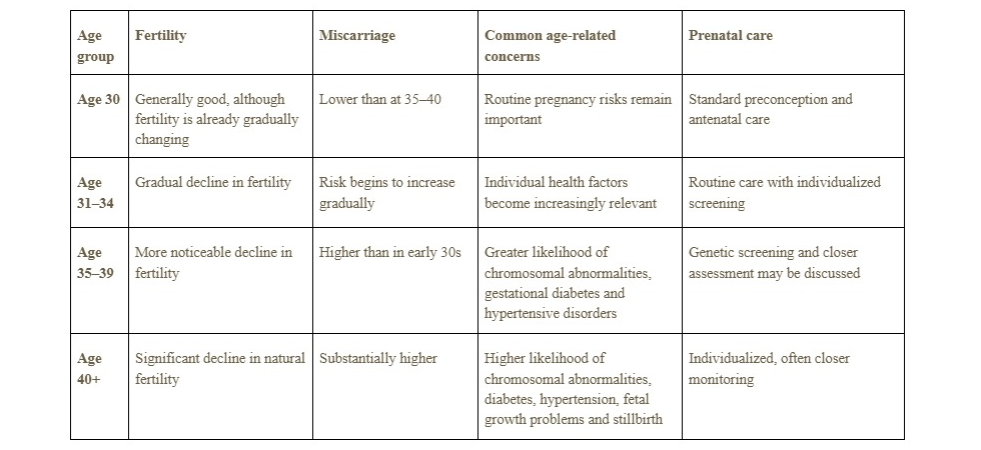
This table is a general guide, not a prediction for an individual woman. A healthy 40-year-old may have a smoother pregnancy than a younger woman with uncontrolled diabetes or hypertension. Medical care should therefore be based on the complete clinical picture.
Pregnancy at Age 30: What Are the Risks?
At 30, many women are still within a period of relatively favourable fertility. However, fertility does not remain constant throughout the 30s. The number and quality of eggs gradually decline with age.
ACOG notes that for healthy couples in their 20s and early 30s, approximately one in four women may become pregnant during a menstrual cycle, while by age 40 the chance is around one in ten per cycle.
For a woman aged 30 who is planning pregnancy, the focus is usually on good preconception health: folic acid, healthy weight, management of existing medical conditions, medication review, vaccination status and appropriate lifestyle habits.
Age 30 itself does not generally require special pregnancy monitoring simply because of the number on the birthday cake.
Pregnancy at Age 31–34: Why Fertility Starts Changing
Between 31 and 34, fertility generally continues to decline gradually. This change may not be obvious because many women in this age group conceive naturally without difficulty.
The important point is that fertility is a continuous biological process rather than a switch that turns off at 35.
ASRM describes female age as the single most important predictor of fecundity and notes that fertility declines with increasing age, with the decline becoming more significant as women approach 40.
For Indian women considering pregnancy during these years, preconception care remains valuable, particularly if there is a history of PCOS, endometriosis, fibroids, irregular periods, previous pelvic surgery, recurrent miscarriage or difficulty conceiving.
Pregnancy at Age 35–39: What Changes?
The term “advanced maternal age” is commonly used in medical literature for pregnancy at 35 years or older. However, 35 should not be understood as a biological deadline. Risk increases progressively rather than suddenly changing on the 35th birthday.
From 35 onward, declining egg quality becomes more relevant. This contributes to a greater likelihood of chromosomal abnormalities and miscarriage. ACOG explains that chromosome abnormalities are a major cause of early pregnancy loss and that the risk of miscarriage increases with maternal age.
Pregnancy at 35–39 may also be associated with a higher likelihood of gestational diabetes, high blood pressure and preeclampsia compared with younger maternal ages.
This is why pregnancy planning in the late 30s should be proactive rather than fearful.
Pregnancy Risks at Age 40+: Why Monitoring Becomes More Important
By 40 and beyond, the decline in fertility is more pronounced. ACOG states that women older than 40 may benefit from fertility evaluation before trying to conceive rather than waiting for several months. ASRM similarly states that more immediate fertility evaluation may be warranted for women over 40.
Miscarriage also becomes more common. ACOG reports that clinically recognized early pregnancy loss increases with age, reaching approximately 40% at age 40 in the cited data, and explains that many early losses are related to chromosomal abnormalities.
Pregnancy after 40 can also carry a greater likelihood of gestational diabetes, hypertensive disorders, fetal growth problems and stillbirth. A large systematic review and meta-analysis found an association between advanced maternal age and stillbirth, with evidence that risk increases further at older maternal ages.
These statistics describe population-level patterns. They do not tell you what will happen in your individual pregnancy.
Chromosomal Risk and Prenatal Testing After 35
One of the most important differences between pregnancy in the early 30s and pregnancy in the late 30s or 40s is the increasing chance of chromosomal abnormalities.
For example, ACOG estimates the chance of a pregnancy affected by Down syndrome at approximately 1 in 714 at age 30, 1 in 294 at age 35 and 1 in 86 at age 40.
This is one reason prenatal screening becomes an important conversation.
Depending on individual circumstances, prenatal care may include first-trimester ultrasound, maternal blood tests, cell-free DNA screening or NIPT, and detailed fetal anatomy ultrasound. Screening tests estimate risk; diagnostic procedures such as chorionic villus sampling or amniocentesis can provide diagnostic information and should be discussed according to individual circumstances.
ACOG recommends that prenatal genetic screening and diagnostic options be discussed with pregnant patients rather than making decisions based solely on age.
Pregnancy After 35 and the Risk of Diabetes and High Blood Pressure
Age is only one part of the picture. Body weight, family history, previous gestational diabetes, PCOS, pre-existing hypertension and other health conditions can significantly influence pregnancy.
Gestational diabetes becomes particularly important because it can affect both mother and baby if blood sugar remains poorly controlled. Similarly, high blood pressure and preeclampsia require careful attention because they can affect placental function and maternal health.
A pre-pregnancy consultation can identify these concerns early. Blood pressure, blood sugar, medications, nutritional status and existing medical conditions can be reviewed before conception rather than discovered after pregnancy begins.
How Prenatal Care Changes With Maternal Age
The purpose of closer monitoring is not to label every older pregnancy as dangerous. It is to identify age-related or individual risk factors early.
Depending on the woman’s medical history, prenatal care may include more detailed ultrasound assessment, screening for chromosomal conditions, gestational diabetes testing, blood pressure monitoring and assessment of fetal growth.
ACOG recommends a detailed fetal anatomical ultrasound for pregnancies in women over 35, particularly when aneuploidy screening or testing has not already provided relevant information.
Women aged 40 and above may also require additional fetal surveillance later in pregnancy depending on their individual risk profile.
When Should an Indian Woman Seek Fertility Advice?
If you are under 35 and have been trying for a year without pregnancy, fertility evaluation is generally recommended. From age 35 onward, evaluation is usually advised after six months of trying. For women over 40, earlier evaluation may be appropriate.
However, you should not necessarily wait even six or twelve months if you have irregular periods, endometriosis, previous pelvic surgery, known fertility problems or another condition that may affect conception.
A fertility consultation does not mean that IVF is automatically required. It is an opportunity to understand what may be affecting conception and what options are available.
The Most Important Message About Pregnancy Risks by Age
The pregnancy risks by age chart should be used as a guide for understanding trends, not as a prediction of your personal pregnancy outcome.
A woman at 30 may require careful antenatal care, while a woman at 40 may have an uncomplicated pregnancy. What changes with age is the probability of certain conditions, not the certainty that they will occur.
If you are planning pregnancy in your 30s or 40s, the best approach is to understand your individual health, prepare before conception, start antenatal care early and discuss appropriate screening with your obstetrician.
Pregnancy after 35 or 40 should not be approached with fear. It should be approached with preparation, informed decision-making and appropriate medical supervision.
About Dr. Shweta Bansal Wazir
Dr. Shweta Bansal Wazir is an Obstetrician and Gynecologist with expertise in high-risk pregnancy and evidence-based obstetric care. She provides individualized guidance for women planning pregnancy, including those conceiving in their late 30s and 40s. Her approach focuses on understanding each woman’s medical history, explaining pregnancy-related risks clearly and creating an appropriate plan for fertility, prenatal screening, antenatal monitoring and delivery.
Dr. Shweta Bansal Wazir
MBBS, DGO, MD (Obs & Gyn), MRCOG (UK)
Obstetrician & Gynecologist | High-Risk Pregnancy & Evidence-Based OB-GYN
Phone: +91 84481 28007
Leave A Comment