For many women, pregnancy becomes emotionally real in a completely new way when they feel their baby move for the first time. Until then, pregnancy may be confirmed by a test, ultrasound or a growing bump. But that first tiny flutter can feel like a personal message from the baby growing inside.
For some Indian women, the first movement may feel like a little bubble, a gentle flutter or a soft rolling sensation. Others may initially wonder whether it was the baby or simply gas. This uncertainty is completely understandable, particularly during a first pregnancy.
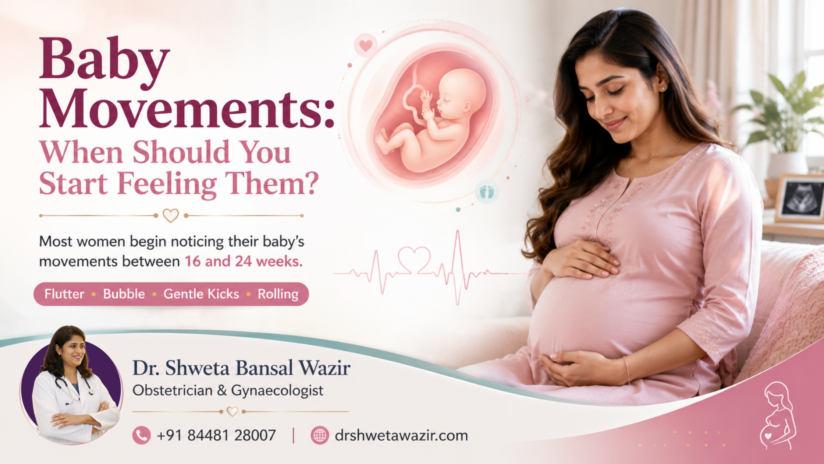
So, when should you start feeling your baby move? Most women begin noticing fetal movements between 16 and 24 weeks of pregnancy. If this is your first baby, it is common not to recognise movements until after 20 weeks. Women who have been pregnant before may notice them somewhat earlier, sometimes around 16 weeks.
Understanding what is normal, what influences when movements are felt, and when reduced movement requires medical attention can help you feel more confident throughout pregnancy.
When Should You Start Feeling Baby Movements in Pregnancy?
The baby begins moving well before the mother can feel those movements. As the pregnancy progresses, the movements become strong enough for the mother to recognise them.
Most women first become aware of baby movements around 18 to 20 weeks. During a first pregnancy, however, recognising those early movements can take longer. If you have been pregnant before, you may identify the sensation earlier because you already know what fetal movement can feel like.
There is therefore no single week that applies to every woman.
If you are 18 weeks pregnant and have not felt anything yet, that does not automatically mean something is wrong. Likewise, feeling your baby slightly earlier or later can still be within the normal range.
What Do Baby Movements Feel Like at First?
Early fetal movements in pregnancy are often surprisingly subtle.
You may notice:
- A gentle flutter
- A bubbling sensation
- A light swishing feeling
- Small taps
- A rolling sensation
- A brief twitch or flick
Many women initially mistake these sensations for gas or digestive movement. As the baby grows and becomes stronger, the difference usually becomes much easier to recognise. Later in pregnancy, movements can feel like clear kicks, stretches, rolls or rhythmic jerking caused by fetal hiccups.
The first movements do not necessarily follow a predictable pattern. You may feel something one day and very little the next during the early stages.
Why Do Some Women Feel Baby Movements Earlier Than Others?
One of the most common questions is, “Why can’t I feel my baby moving yet?”
The answer is that several factors can influence when fetal movement becomes noticeable.
First Pregnancy and Previous Pregnancy
Women experiencing their first pregnancy may take longer to recognise fetal movement because the sensation is unfamiliar. A woman who has already experienced pregnancy may identify the same subtle movement more easily.
This does not mean that the baby is not moving. It may simply mean that the mother has not yet learned to recognise the sensation.
Position of the Placenta
The location of the placenta can influence how movements are perceived. An anterior placenta, positioned toward the front of the uterus, may cushion some movements and make them harder to notice, particularly earlier in pregnancy. Evidence on how strongly placental location affects movement perception is mixed, so it should not be assumed to explain every case of reduced movement.
Your ultrasound report can usually tell you where your placenta is located.
Your Baby’s Position and Activity
Babies have periods of activity and rest. You may notice movement more clearly when you are sitting quietly than when you are busy walking, working or doing household activities.
Fetal movements also change as the baby grows. The strength and type of movement can become more obvious as pregnancy progresses.
Your Own Activity During the Day
An active mother may simply notice fewer movements because her attention is occupied by work, travel, household responsibilities or other activities.
This is particularly relevant for women managing busy daily routines. A quiet period when you can pay attention to your body may make subtle movements easier to recognise.
Baby Movements by Pregnancy Week: What Can You Expect?
Every pregnancy is individual, but knowing the general progression can make the experience less confusing.
Baby Movements at 16–20 Weeks
Some women begin noticing movement during this period, particularly if they have been pregnant before. For a first-time mother, the sensation may still be difficult to identify.
At around 18 weeks, the movement may resemble bubbling or fluttering.
Baby Movements at 20–24 Weeks
Movements generally become easier to recognise during this period. You may begin noticing more definite kicks, rolls or shifting sensations.
If you have reached 24 weeks and have never felt your baby move, it is important to contact your maternity care provider for assessment rather than simply waiting.
Baby Movements After 24 Weeks
As pregnancy progresses, movements generally become more noticeable and develop an individual pattern.
Your baby may have periods when they are particularly active and other periods when they are quieter. Fetal sleep periods are normal and can occur during both day and night.
Baby Movements After 32 Weeks
A common misconception is that babies naturally stop moving as much because there is less room in the uterus.
This is not a reason to ignore reduced movement. Although the type of movement may change as pregnancy advances, you should continue to feel your baby move throughout pregnancy, including toward labour.
Is There a Normal Number of Baby Movements Each Day?
There is no universal number of movements that every pregnant woman should feel each day.
Every baby develops an individual movement pattern. Rather than comparing your baby with your sister, friend, neighbour or another pregnant woman, it is more useful to become familiar with your baby’s usual pattern.
Some healthcare providers may recommend fetal movement counting or “kick counts” in particular circumstances. However, routine movement charts are not universally recommended for every pregnancy. Your obstetrician can advise you whether formal counting is appropriate for your pregnancy.
What If Your Baby Is Moving Less Than Usual?
This is the most important part of understanding fetal movements.
If you have already established a pattern of movements and suddenly notice that your baby is moving less than usual, has stopped moving, or the pattern feels significantly different, do not ignore it.
Reduced fetal movement can sometimes be an early sign that the baby needs assessment. Research has linked maternal perception of reduced fetal movement with important pregnancy complications, including fetal growth restriction and placental problems.
The safest response is to contact your obstetrician, maternity unit or appropriate pregnancy-care service promptly. Do not wait until the following day simply to see whether movement returns.
Should You Use a Home Doppler If Baby Movements Decrease?
A home fetal Doppler should not be used as a substitute for professional assessment.
Hearing a heartbeat at home does not reliably confirm that your baby is well. A person without appropriate training may also mistake other sounds or their own pulse for the baby’s heartbeat.
If you are worried because your baby is moving less, professional assessment is more important than trying to reassure yourself with a home device.
When Should an Indian Pregnant Woman Contact Her Doctor?
If you are pregnant in India and concerned about your baby’s movements, do not feel that you are “overreacting” by contacting your obstetrician.
Seek medical advice promptly if:
- You notice a clear reduction in your baby’s usual movements.
- Your baby stops moving.
- The usual pattern changes significantly.
- You have never felt movement by 24 weeks.
- You are worried that something does not feel right.
The exact assessment depends on your gestational age, pregnancy history and individual circumstances. Your doctor may check the baby’s heartbeat and, when appropriate, arrange further monitoring or ultrasound assessment.
How Can You Become Familiar With Your Baby’s Movement Pattern?
Once movements become established, try to notice when your baby is usually active.
You may notice more activity during particular periods, such as the afternoon or evening. However, there is no need to force your baby to move or compare the timing with another pregnancy.
Instead, think of fetal movement as a communication pattern that becomes familiar over time.
You do not need to become anxious about every quiet moment. What matters is recognising a meaningful change from what is normal for your baby.
Frequently Asked Questions About Baby Movements
Can I feel my baby move at 16 weeks?
Yes, some women may notice movement around 16 weeks, particularly if they have been pregnant before. However, many women do not recognise movements until later, and first-time mothers may not feel them until after 20 weeks.
What if I am 20 weeks pregnant and still cannot feel my baby?
This can still occur, especially during a first pregnancy. However, if you reach 24 weeks without ever feeling movement, contact your pregnancy-care provider for an assessment.
Does an anterior placenta mean something is wrong?
No. An anterior placenta is a normal placental position. It may make some movements more difficult to perceive, particularly earlier in pregnancy. However, a change in established fetal movement should not automatically be attributed to placental position.
Should baby movements reduce near the due date?
No. Movements may feel different as pregnancy progresses, but they should not simply disappear because the baby has less space. You should continue to feel your baby move until labour.
A Reassuring Message for Every Mother
The first baby movement is one of pregnancy’s most memorable milestones, but there is no perfect timetable that every woman must follow.
Some mothers notice fluttering at 16 or 17 weeks. Others recognise it around 20 weeks or later. The important thing is to understand your own pregnancy rather than compare yourself with someone else’s experience.
Once your baby’s movements become established, they become an important part of understanding your baby’s wellbeing. If the movements become noticeably reduced or change from their usual pattern, trust your concern and seek professional medical advice promptly.
Pregnancy is full of questions, and asking for reassurance is not a sign of weakness. For an Indian woman navigating pregnancy alongside family responsibilities, work and everyday life, knowing what to expect can make the journey calmer and more confident.
Dr. Shweta Bansal Wazir provides obstetric and gynaecological care with a patient-centred approach, helping women understand pregnancy changes and make informed decisions about their health. For consultations and pregnancy-related concerns, contact +91 84481 28007 or visit drshwetawazir.com.



Leave A Comment