For an athlete, missing a period can seem like a minor inconvenience. Training is demanding, competitions are approaching, and there may be little time to think about menstrual health. Some women simply assume that irregular periods are a normal consequence of exercising intensely.
But a menstrual cycle can provide valuable information about a woman’s overall health.
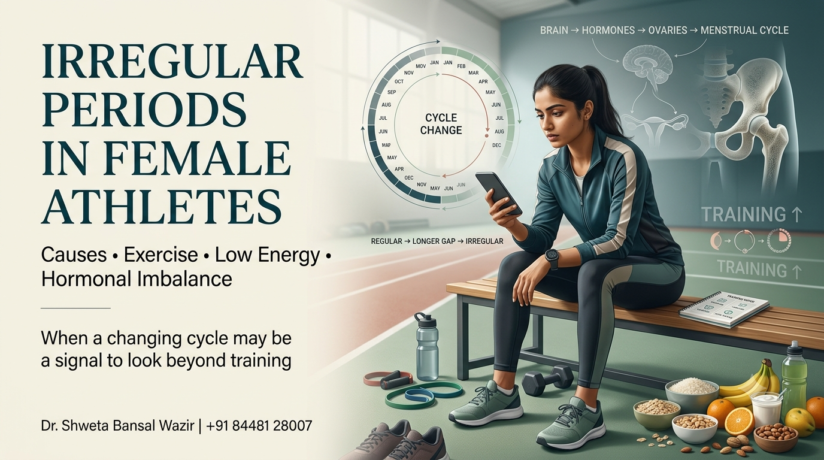
When periods become irregular, unusually light, widely spaced or disappear altogether, the change deserves attention. It may be related to intense training, insufficient calorie intake, rapid weight loss or low energy availability. But hormonal conditions such as PCOS, thyroid disorders and other medical problems can cause similar symptoms.
Understanding the reason behind the change is important because prolonged menstrual dysfunction can affect more than fertility. It may also have consequences for bone health, energy, recovery and athletic performance.
What Are Irregular Periods in Female Athletes?
Irregular periods in female athletes refer to menstrual cycles that become noticeably different from the woman’s usual pattern. This can include periods arriving much earlier or later than expected, increasingly long gaps between cycles, unusually light bleeding or periods stopping completely.
For adult women, a menstrual cycle commonly falls within a range of about 21 to 35 days, although individual patterns vary. A previously regular cycle that suddenly becomes irregular deserves assessment rather than being automatically attributed to exercise.
For teenage athletes, cycles can naturally be less predictable during the first few years after menstruation begins. However, prolonged gaps should still be discussed with a healthcare professional, particularly when exercise, weight loss or restricted eating is also present.
Can Intense Exercise Cause Irregular Periods?
Exercise itself is not the problem.
Regular physical activity has many benefits for physical and mental health. The concern arises when the demands of training become greater than the energy and nutritional resources available to the body.
An athlete may train for several hours a day while eating too little to compensate for the energy being used. This can happen intentionally, such as when someone is trying to lose weight, or unintentionally because training has suddenly increased.
The IOC describes low energy availability as a situation in which dietary energy intake does not adequately cover the body’s needs after exercise. When this becomes prolonged or severe, it can contribute to Relative Energy Deficiency in Sport, or REDs, which may affect reproductive function, bone health, immunity, metabolism and performance.
This is why a missed period should not automatically be celebrated as evidence of intense training or successful weight control.
Low Calorie Intake and Periods: Why Nutrition Matters
An athlete’s body needs energy for much more than exercise.
Calories are required to support the brain, heart, muscles, reproductive system, immune function, temperature regulation and everyday activities. When food intake consistently falls short of overall needs, the body may adapt by reducing energy expenditure in certain physiological systems.
Reproductive hormone signalling can be affected.
This may lead to less frequent periods or eventually amenorrhea, meaning the absence of menstrual periods.
Low energy availability can occur even when a woman does not appear extremely underweight. An athlete may have a seemingly normal body weight but still not consume enough energy relative to her training demands.
This is particularly relevant in endurance sports and sports where athletes feel pressure to maintain a particular body shape or low body weight.
Weight Loss and Irregular Periods in Female Athletes
Weight changes can influence menstrual function, particularly when weight is lost rapidly or accompanied by restrictive eating.
An athlete may begin with a reasonable goal such as improving fitness but gradually become overly focused on body weight. Meals become smaller, carbohydrates may be severely restricted, or entire food groups may be eliminated.
At the same time, training continues or becomes more intense.
Eventually, the body may begin showing signs that it is struggling to meet its nutritional demands. Fatigue, reduced performance, recurrent injuries and menstrual changes can appear together.
ACOG identifies weight loss, low energy, restrictive eating, irregular or missed periods and stress fractures among warning signs that can occur in female athletes with the female athlete triad.
Amenorrhea in Female Athletes: When Periods Stop
When a woman who previously menstruated does not have a period for three months or longer, this is generally considered secondary amenorrhea and deserves medical evaluation.
In an athlete, one possible cause is functional hypothalamic amenorrhea, in which changes in energy availability, stress or exercise can interfere with the hormonal signals that regulate ovulation and menstruation.
However, it is important not to assume that exercise is automatically responsible.
Pregnancy, PCOS, thyroid disorders, elevated prolactin, primary ovarian insufficiency, certain medications, significant stress and other medical conditions can also cause periods to stop.
Therefore, a sportswoman with amenorrhea should be evaluated rather than simply told to reduce exercise.
Hormonal Imbalance and Irregular Periods: Is Exercise Always the Cause?
This is where proper medical evaluation becomes important.
Two athletes can have exactly the same training schedule but completely different reasons for irregular periods.
One may have inadequate energy intake. Another may have PCOS. A third may have a thyroid disorder. Another may be experiencing significant psychological stress.
Hormonal imbalance is therefore not a diagnosis that should be made simply because periods are irregular.
A gynecologist may ask about menstrual history, recent weight changes, eating habits, exercise intensity, sleep, stress, medications and other symptoms. Depending on the situation, pregnancy testing, blood tests or ultrasound may be recommended. ACOG notes that evaluation of amenorrhea can include medical history, examination, hormone testing and ultrasound, depending on the individual case.
Irregular Periods and Bone Health
One of the biggest reasons athletes should take menstrual changes seriously is bone health.
Estrogen plays an important role in maintaining bone strength. When prolonged menstrual dysfunction is associated with reduced estrogen and low energy availability, bone health may be affected.
This can increase concern about bone stress injuries and stress fractures, particularly when other risk factors are present. ACOG describes the connection between irregular or missed periods, low estrogen and weakened bones in female athletes.
An athlete who repeatedly experiences stress fractures should therefore be assessed beyond the immediate injury. Menstrual health, nutrition, training load and recovery may all be relevant.
Can Irregular Periods Affect Fertility?
Irregular periods do not automatically mean that a woman is infertile.
However, if menstrual irregularity is caused by disrupted ovulation, conception can become more difficult because ovulation may not occur regularly.
When low energy availability is responsible for menstrual dysfunction, improving nutrition and addressing the underlying energy imbalance may help restore reproductive function. The appropriate treatment depends on the cause.
This is particularly important for athletes who are planning pregnancy in the future. A woman should not assume that several years of absent or highly irregular periods are harmless simply because she is not trying to conceive right now.
Reproductive health is part of long-term athletic health.
How Can Female Athletes Support Healthy Periods?
The goal is not to stop exercising.
Instead, athletes should aim for an appropriate balance between training, nutrition and recovery.
Important considerations include:
Eat enough for your training load. Your nutritional needs may increase when training intensity or duration increases.
Avoid unnecessary restrictive diets. Cutting calories aggressively can create an energy deficit even when body weight appears healthy.
Include adequate carbohydrates, protein and fats. Different sports have different nutritional demands, and a sports dietitian can help create an appropriate plan.
Allow recovery time. Rest is part of training, not a sign of weakness.
Monitor your menstrual cycle. Tracking periods can help identify changes before they become prolonged.
Take recurring injuries seriously. Repeated stress injuries may be an indication that something beyond the injury itself needs attention.
IOC guidance emphasises prevention and early identification of problematic low energy availability rather than waiting until more serious health consequences develop.
When Should an Athlete See a Gynecologist?
A female athlete should consider medical evaluation if:
- Her previously regular periods become irregular
- She has no period for three months or longer
- Periods repeatedly become very far apart
- She experiences significant or rapid weight loss
- She follows a highly restrictive diet
- She has persistent fatigue or reduced performance
- She develops repeated stress fractures or bone injuries
- She has symptoms suggesting PCOS or thyroid problems
- She is concerned about fertility
- Menstrual changes continue despite changes in training or nutrition
A woman does not need to wait until her periods completely disappear before seeking help.
Early evaluation can help identify the cause and prevent a temporary menstrual change from becoming a longer-term health concern.
What Happens During an Evaluation for Irregular Periods?
A consultation usually begins with questions rather than immediately ordering a large number of tests.
Your gynecologist may want to know when your periods started, how regular they were previously, how your training has changed, whether your weight has changed, what you eat, whether you are restricting certain foods and whether you have experienced injuries.
The doctor may also ask about medications, stress, sleep, pregnancy possibility and symptoms such as acne, excess facial hair, headaches or thyroid-related complaints.
Depending on the history, investigations may include pregnancy testing, blood tests for hormones or other conditions and pelvic ultrasound.
The purpose is to identify the cause rather than simply make the period return temporarily.
Irregular Periods Are a Health Signal, Not a Measure of Athletic Success
A strong athlete is not defined by how little she eats, how much she trains or whether she can exercise through exhaustion.
If periods become irregular, the change deserves attention.
Sometimes the reason may be intense training combined with inadequate energy intake. Sometimes it may be a hormonal or medical condition completely unrelated to exercise. Either way, identifying the cause is more important than simply accepting irregular periods as “normal for athletes.”
For girls and women involved in sports, menstrual health should be considered part of overall health and performance.
About Dr. Shweta Bansal Wazir
Dr. Shweta Bansal Wazir, MBBS, DGO, MD (Obs & Gyn), MRCOG (UK), is an Obstetrician and Gynecologist providing evidence-based care for women’s reproductive and hormonal health. Her approach includes personalised evaluation of menstrual irregularities, hormonal concerns, fertility and pregnancy-related needs, with attention to the individual lifestyle and health circumstances of each patient.
For personalised consultation regarding irregular periods, amenorrhea, hormonal concerns or reproductive health, contact Dr. Shweta Bansal Wazir at +91 84481 28007.



Leave A Comment