For many Indian women, the decision to have a baby does not happen according to a fixed timeline. Education, career, marriage, financial responsibilities, personal goals and family circumstances can all influence when pregnancy feels right.
Then, sometimes in the early or mid-30s, a woman begins hearing a question that can create unnecessary anxiety: “Is it already too late?”
The truth is more reassuring and more nuanced. There is no single pregnancy age limit that applies to every woman. However, female fertility does change with age, and understanding these changes can help women make informed decisions rather than waiting until fertility becomes an unexpected concern.
What Is the Best Age to Get Pregnant?
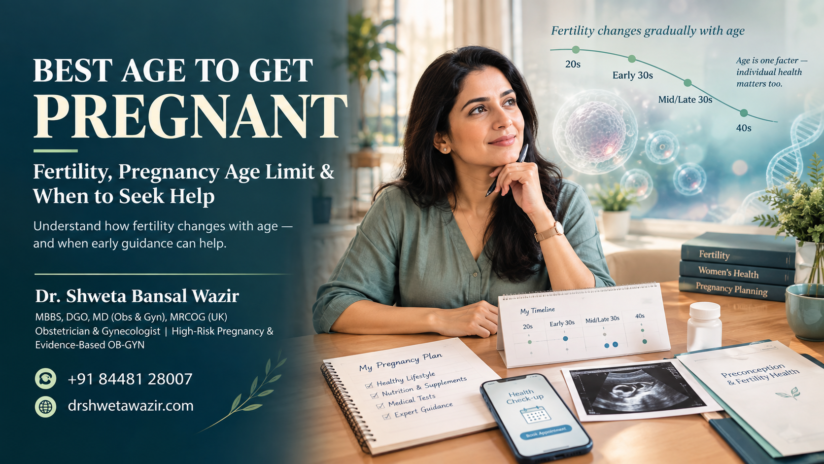
From a biological perspective, female fertility is highest during the 20s and begins to decline gradually around age 30, with a more noticeable decline during the mid-30s. By around 40, the chance of natural conception in any individual menstrual cycle is considerably lower than in the late 20s and early 30s.
This does not mean that pregnancy after 35 is unusual or impossible. Many women conceive naturally and have healthy pregnancies in their late 30s and 40s.
Instead of thinking about a particular age as a deadline, it is more useful to understand that fertility is a gradual biological process. The question is not simply, “Am I too old?” but rather, “What does my age mean for my fertility, and should I plan differently?”
Pregnancy Age Limit: Is There a Strict Age Limit for Pregnancy?
There is no universal biological age at which pregnancy suddenly becomes impossible.
Natural fertility eventually ends with menopause, but fertility usually declines substantially before menopause occurs. By age 45, natural pregnancy is uncommon, according to ACOG.
This distinction is important because women sometimes confuse menopause with the beginning of declining fertility. They are not the same.
A woman may continue to have regular periods while her ovarian reserve and egg quality are already changing. Therefore, having regular menstrual cycles does not necessarily mean fertility is unchanged.
For women considering pregnancy later in life, an individual assessment is much more meaningful than relying on an age number alone.
Why Does Female Fertility Decline With Age?
A woman is born with the eggs that she will have throughout her reproductive life. As she grows older, both the number of remaining eggs and, importantly, the likelihood that an egg will have normal chromosomes change.
With increasing age, eggs are more likely to develop chromosomal abnormalities during the process of maturation. This contributes to lower fertility, a higher chance of miscarriage and an increased likelihood of certain chromosomal conditions in pregnancy.
This is one reason why age has such an important role in fertility.
It is also why tests that measure ovarian reserve cannot completely answer the question, “Can I get pregnant?”
A woman can have a reasonable ovarian reserve measurement and still experience age-related changes in egg quality. Conversely, a lower ovarian reserve result does not automatically mean pregnancy is impossible. ASRM recommends interpreting ovarian reserve tests alongside age, medical history and the overall clinical picture rather than using them as a standalone fertility prediction.
Getting Pregnant in Your 20s, 30s and 40s
Every woman’s reproductive journey is different, but understanding broad age-related patterns can be useful.
During the 20s and early 30s, natural fertility is generally at its strongest. ACOG notes that healthy couples in their 20s and early 30s may have approximately a one-in-four chance of pregnancy in a given menstrual cycle.
During the mid-to-late 30s, fertility gradually declines and the decline becomes more noticeable. This does not mean that a woman should assume she will have difficulty conceiving, but it does mean that delaying pregnancy for several additional years can have a greater biological impact.
In the 40s, natural conception can still occur, but the monthly probability is lower and pregnancy-related risks increase. ACOG reports that around age 40, approximately one in ten women may become pregnant in an individual menstrual cycle.
These are population-level figures, not a prediction of an individual woman’s fertility.
Pregnancy After 35: What Changes?
The term “advanced maternal age” has traditionally been associated with pregnancy at 35 or older. However, ACOG emphasises that 35 is an historical threshold rather than a sudden biological dividing line. Many risks increase gradually with age, and some become more pronounced at 40 and beyond.
For women over 35, pregnancy may carry a higher risk of miscarriage, chromosomal abnormalities and certain pregnancy complications. Depending on individual circumstances, doctors may recommend additional monitoring or investigations.
The important message is that age does not automatically make a pregnancy high-risk in the same way for every woman. Medical history, blood pressure, weight, diabetes, thyroid conditions, previous pregnancy outcomes, fertility history and other factors also matter.
Pregnancy After 40: Should You Wait or Seek Advice First?
For an Indian woman in her 40s who wants to become pregnant, waiting several months before discussing fertility may not always be the best approach.
ACOG recommends that women older than 40 consider an infertility evaluation before trying to conceive, while ASRM states that more immediate evaluation may be appropriate for women over 40.
A preconception consultation can identify issues that may affect fertility or pregnancy and provide an opportunity to discuss realistic options.
This does not mean that every woman over 40 will need IVF. It means that time becomes an important consideration, and early information can help a woman understand her choices.
When Should You See a Fertility Specialist?
The timing of fertility evaluation depends on age and medical history.
For women younger than 35, evaluation is generally recommended after 12 months of regular unprotected intercourse without pregnancy when there are no obvious fertility concerns.
For women aged 35 or older, evaluation is generally recommended after six months of trying.
For women over 40, earlier evaluation may be appropriate, sometimes even before attempting pregnancy.
You should also seek medical advice sooner if you have irregular or absent periods, suspected endometriosis, PCOS, previous pelvic surgery, recurrent pregnancy loss or another condition known to affect fertility.
IVF and Pregnancy After 35 or 40
When natural conception becomes difficult, assisted reproductive technologies such as IVF may provide additional options.
However, IVF does not completely remove the effect of age. The age of the woman providing the eggs remains an important factor because egg quality changes with age. Research has shown that age-related decline in oocyte competence affects IVF outcomes as well as natural fertility.
Depending on an individual’s circumstances, fertility specialists may discuss options such as IVF, embryo freezing, egg freezing or donor eggs.
These are highly individual decisions. The right approach depends on age, ovarian reserve, previous fertility history, medical conditions, partner factors and personal reproductive goals.
How Indian Women Can Prepare for a Healthy Pregnancy
Age is only one part of pregnancy planning.
Before trying to conceive, women can benefit from a preconception consultation, especially when pregnancy is planned after 35. This allows a doctor to review existing medical conditions, medications, menstrual history, previous pregnancies and lifestyle factors.
Folic acid supplementation, appropriate nutrition, physical activity, healthy weight management, avoidance of tobacco and alcohol, and control of conditions such as diabetes or hypertension are important parts of pregnancy preparation.
Most importantly, do not let online fertility stories create either false reassurance or unnecessary fear.
A 39-year-old woman who conceived naturally after one month and a 32-year-old woman who required fertility treatment are both real possibilities. Fertility is individual.
The Right Question Is Not “Am I Too Old?”
For women thinking about pregnancy, age is worth understanding, but it should not become a source of panic.
There is no universal pregnancy age limit that suddenly closes the door to motherhood. At the same time, fertility does decline with age, particularly during the later 30s and 40s, and the decline in egg quality can affect both conception and pregnancy outcomes.
The most useful approach is proactive rather than fearful.
If you know you want children but are planning to delay pregnancy, discuss your reproductive plans with your gynaecologist. If you are over 35 and have been trying without success, do not wait indefinitely before seeking advice. And if you are over 40, consider getting fertility guidance before you begin trying.
The goal is not to make women feel pressured by a biological clock. It is to give them accurate information early enough to make choices with greater confidence.
About Dr. Shweta Bansal Wazir
Dr. Shweta Bansal Wazir, MBBS, DGO, MD (Obs & Gyn), MRCOG (UK), is an Obstetrician and Gynecologist with expertise in evidence-based obstetric and gynecological care, including fertility concerns, pregnancy planning and high-risk pregnancy management. Her approach focuses on helping women understand their reproductive health, identify potential concerns early and make informed decisions based on their individual medical history rather than age alone.
For consultation and pregnancy or fertility-related guidance:
Dr. Shweta Bansal Wazir
Obstetrician & Gynecologist | High-Risk Pregnancy | Evidence-Based OB-GYN
Phone: +91 84481 28007
Website: drshwetawazir.com



Leave A Comment